

Taking My Mind Back Redux

This one is just a short update. A few years ago, I deleted my Facebook, Twitter, Instagram, and Threads accounts. This morning, after a nineteen year run there, I’ve added Reddit to that list, having deleting my account there about an hour ago.

And I did so for the same reason as the others: I realized that time spent there was wasted, not utilized. It was a little more difficult, because good conversations can be had there, but as with most other social media, it was just too easy to get drawn into ideological conflicts.

So that’s it: so long, Reddit. You’ve been permanently downvoted. And that leaves me on only two social media networks, ones I’m very likely to keep, even though they’re polar opposites.

The first is my Mastodon account in the Fediverse, which is designed totally differently from other social networks and actually promotes conversation rather than serving up endless outrage to keep people’s attention. If anything, it was difficult to get used to it, because it doesn’t try to keep you doomscrolling—sticking around is entirely up to you.

The second is LinkedIn. I get it, people think of that as just a hub of self-promotion and AI slop, and it’s certainly no paradise. But I have a lot of businessy interests and do a lot of businessy stuff, and that makes it the only social media network where I see posts that actually tell me things I didn’t know that might help me reach my goals. So it stays, at least as long as that remains true.

An Open Letter to the Editor of GlobalPost

Dear Editor:

With respect to your article “Puerto Ricans Struggle To Find Their Feet as Bad Bunny ‘Puts Them on the Map’” published on February 27th, I was astonished that the entire focus was on their prospects for independence. Your unfounded and unchecked presumption that this must be what most Puerto Ricans want deformed your article entirely out of alignment with the truth.

The majority of Puerto Ricans do not want their island to become an independent country. There have been a variety of referenda over the years regarding the island’s status relative to the United States. In the most recent one, in 2024, Puerto Ricans had a choice between statehood, free association with the United States, and independence. The majority, 58.6%, voted for statehood. Most of the rest, 29.6%, voted for free association. Independence was a distant third at 11.8%—fewer than one in eight votes. Moreover, support for statehood was widespread, earning a majority in all but one of Puerto Rico’s 78 municipalities.

Perhaps you would have run into information about this referendum had you started out with impartial, fact-driven sources to familiarize yourself with the situation. Instead, you openly cited Cuban propaganda, by name. With sources like this, it’s no wonder your article ended up being a counterfactual travesty.

I should add that my shock and disappointment is not derived from nationalist sentiment but simply from your lack of commitment to accuracy. If Puerto Ricans wanted independence I would wholeheartedly support them. Most do not.

Were this simply a matter of getting a single article woefully wrong, then that might be one thing. But the real problem is that when I see things go so far astray on a topic with which I am passably familiar, then I cannot trust your reporting on topics about which I know little or nothing. You have sown doubt about everything I read in your newsletter, undermining any reason to continue doing so.

Sincerely,

Steve Foerster


Note: I would have loved to link to the article in question so that anyone reading this could make up their own mind about my criticism. Unfortunately, as far as I can determine, GlobalPost only makes their articles available via their newsletter, not on the publicly viewable Internet, even behind a paywall.

Republicans: Not Even Once

Especially since as an educator I typically travel in left-learning circles, when people find out that I’d rather that government were smaller and more decentralized, they sometimes get the wrong impression that I might be sympathetic to the Republicans. Not only is that not true now, that has actually never been true.

As Barack Obama says, “Let me be clear.”

Republicans have never meant it when it comes to being the party of small government. Never. Not about taxes, not about spending, not about federalism, not about separation of powers, not about judicial restraint, not about freedom of religion, not about gun rights, not about wars, not about free speech.

They have promised modest, decentralized government my whole life and never missed an opportunity to prove that all they really want is power and control.

On the contrary, I’ve watched them go from—correctly—referring to ATF agents as jackbooted thugs after the Waco and Ruby Ridge massacres to building their own latter-day Schutzstaffel to run wild in our cities.

For a long time I avoided using Nazi rhetoric to describe this administration. By nature, I’m not an “everyone I don’t like is Hitler” sort of person. But I’m also not blind, so as Bob Marley sang, “Who the cap fit, let them wear it.”

So the bottom line is this: the Republicans must be defeated and made sure never to be allowed anywhere near political power ever again. And I say that not despite being a proponent of smaller government, but because I am one. I say it because the Republicans have taught me that Karl Popper was right to warn us about the paradox of tolerance. Simply put, I want my children and grandchildren to live in a pluralistic, cosmopolitan, and prosperous society, and the Republicans have conclusively demonstrated that they are the enemy of such a society, and have nothing to offer in its place other than violence, hatred, and fear.

“Liberation Day” Is Anything But

The Financial Times has a good summary of the idiocy of this week’s tariffs imposed by the Trump administration.

It’s often exaggerated how much control presidents have over the economy. They get too much credit when times are good (even when it’s a president one likes) and they get too much blame when times are bad (even when it’s a president one dislikes). But handing the power to unilaterally set tariffs to one person has turned out to be a catastrophe, and when the inflation and recession come, for once the blame really will belong squarely in the Oval Office.

And this is worse than Donald Trump merely being economically illiterate. We knew that. He’s hardly the only politician who is, usually we can survive that. But that he would implement such an embarrassingly incompetent plan shows that not only is he clueless, he also doesn’t listen to anyone around him who might be able to warn him about the consequences of his idiotic policies.

The focus on trade bilateral trade deficits really highlights this, because it has all the sophistication of being outraged at the grocery store because you buy so much from them and they don’t buy anything from you in return.

If it weren’t so sad, it would be funny that he’s even got his administration referring to this as “Liberation Day”. He said it will be a day we remember, and that much is probably true, although it will be in the way that we remember the Smoot-Hawley tariffs. Former Trump staffer Anthony Scaramucci was right to refer to this as “Liquidation Day”, because that’s what we’re going to see happen to businesses in the US and beyond.

Anyway, buckle up. Trump’s slamming on the brakes of the economy and he’s going to take the whole world with him.

Looking Forward to 2025!

For the most part I covered everything major in my professional life from the past year in my two recent posts, My Secret Life Revealed! and Success Learning Center. If you’d like to be up to date, start there. But as we get into the first work week of the new year, I wanted to reflect on a few other highlights from 2024 and what I’m excited about the most in 2025.

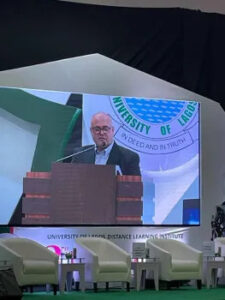
Steve at UnilagPerhaps the greatest experience I had this past year was in August on one of my trips to Lagos, Nigeria. I was asked to deliver remarks about distance learning at the 3rd International Colloquium at the University of Lagos Distance Learning Institute. The theme was “The Massive and Ubiquitous Intrusion of the Educational Landscape by Artificial Intelligence: Whither Open, Flexible and Distance Learning?” and the guest list was an impressive array of distance learning experts both from Nigeria and abroad. Of special note was that I finally had the opportunity to meet my longtime friend Ramesh Sharma in person after many years of online acquaintance. 

Another big moment came as the year was winding down in December. I’ve written recently about how conversations with my friend Rich Douglas helped me to revise how I think about my professional life, and not long afterwards I was a guest on the podcast that he hosts for the Bellevue University’s Human Capital Lab. That episode went live this week, the first great thing about 2025 for me:


I get it, a lot of people are guests on shows all the time, so you may be thinking, “Come on, Steve, this is not that big a deal.” Maybe not. But I haven’t really done significant media before and I know that this year will be quite different when it comes to that, so having the first time out be done (and that I didn’t sound like a total ignoramus) is pretty exciting for me.

As for what’s to come, the most exciting thing is that Success Learning Center will be open for business in about a month. Kola Bakare, this is our year, brother!

My Secret Life Revealed!

As I recently posted, for many years I’ve been working on bringing New World University into fruition. It’s been the public focus of my professional identity, but it’s not all I’ve been doing. It’s time I finally revealed my secret life… in training and development.

Since 2013 my day job has been directing e-learning for the training team at Cogent Communications, a tier 1 Internet service provider. I’ve never put my job at Cogent on my LinkedIn profile, or otherwise talked about it other than to very close friends, because I was concerned that it would be more difficult to be taken seriously as head of a higher education project if it were understood that I also have a day job doing something else.

Lately, however, I’ve since been having conversations with my friend Rich Douglas, a longtime higher education and training and development expert who now serves as Executive Director of Bellevue University’s Human Capital Lab. Talking to Rich and others who are participating with HCL has made me realize how much I’ve learned from being in corporate training that differs and complements a lot of conventional wisdom in higher education, to the point where it’s informed the way I approach higher education.

In fact, it’s part of the reason why my partners and I have split our project into two parts: Success Learning Center to offer business and other professional training, and New World University to offer a means to wrap up that training into a set of academic credentials. Put simply, academic and vocational education can work in concert.

That means that listing my time at Cogent is an important part of my story, even as it relates to making higher education more accessible to students in lower income countries. And in listing it after all this time, I felt that I should probably explain why.

So, as Paul Harvey might say, “And now you know… the rest of the story.”

Success Learning Center

For many years, I’ve been putting together New World University, a distance learning university meant to make higher education more accessible to students in lower income countries. As one might imagine, it’s not an easy goal to reach. It took several years just to find the right people to build it with, most notably Kola Bakare, my brother from another mother. Then we spent five years running a pilot project, putting together a complete curriculum for a degree in business administration from open educational resources, recruiting students willing to spend their time being our product testers, going through the entire program, and then reviewing what we’d learned as preparation for how to continue at scale.

We always knew that we were interested in focusing on professional programs, ones that would help our students build their careers. Ultimately, we realized that there was a way to provide this education to benefit both students who were interested in learning enough to get their foot in the door with a certification or two, as well as students who were interested in the longer term commitment required to complete a degree. We had also learned from running our pilot project that while online learning may be convenient, many students were keen to have somewhere physical to go to interact with their fellow students and to be in a better position to get to know the faculty members who were teaching them.

This led us to create two closely connected but distinct organizations. The first is New World University itself, which after significant consideration we’ve decided to base in the US, ultimately seeking accreditation from DEAC, an agency approved by the US Department of Education. The second is Success Learning Center in Lagos, Nigeria, a physical location with classrooms, academic advisors, career counselors, and regularly scheduled tutorial sessions so that students can get the hybrid learning experience that they’ve told us they want.

Success Learning Center is already in place and scheduled to open in the first quarter of the new year. The facility we’d been building to serve as a headquarters for New World University is simply being reallocated for that new purpose. And as an organization we are now a member of the Nigerian Institute of Training and Development, which means we’re authorized to design, build, and deploy certificate programs and market them to Nigerian students.

So if we’re running full speed ahead with certificate programs, what’s the use of New World University? Each and every program that Success Learning Center develops will use resources from New World University, and both organizations will offer them. That way, when students have earned enough certifications through the training center, they can stack them into an Associate or Bachelor degree from the university, and meet both their short term and longer term goals, both in terms of education and credentials.

We’re pretty excited about this approach: short term certificates for those whose needs are immediate, degree programs for those who are planning ahead, hybrid courses for those who want that face-to-face interaction, and online-only courses for those who want to maximize convenience, all within the same educational ecosystem.

Drag Queens at the Last Supper

I don’t watch the Olympics, so I initially missed the Current Thing among social conservatives of drag queens reenacting the Last Supper during the opening ceremonies in Paris.

But even though I’ve done well lately to insulate myself from social media nonsense, the outrage du jour is hard to avoid completely. Well, now I’ve seen it, and as someone who goes to church every Sunday, I think if Jesus were walking around today that those are exactly the people he’d be spending time with, not the Pharisaical among his supposed followers.

He came for everyone, and his chosen were always the downtrodden and oppressed. He dined with the outcasts of society then; he’d dine with our outcasts now.

I know what it says in Leviticus, etc., I’ve read the whole book. And the same passages that describe these issues also warn of dire consequences for eating shellfish and mixing fabrics, yet one never sees social conservatives railing against the ungodliness of cotton-poly blends or lobster rolls. Either way, the point of the new covenant is that it washes away the old, and throughout all four Gospels, Jesus referred to these issues exactly zero times.

What did he talk about instead? Avoiding judgment and professing love for one’s neighbors. And he talked about it a lot. He would have loved every one of those drag queens, neither would he have condemned them. And if social conservatives really want to take up his cross and follow him as they so often claim, then they would do likewise.

Taking My Mind Back

I’ve written a few times on my struggles with commercial social media and my approach to using it, and this is in particular a follow up to Sorry Twitter, It’s Not Me, It’s You. 

Of course, when I say “my struggles” I’m sure they’re not all that different from those that many people have. The first and foremost issue is that, on balance, it’s a giant waste of time. Yes, I have learned a few things that were helpful from friends and other contacts, and I’ve occasionally gotten updates about people I know that I was grateful to know about. But what percent of posts on Facebook or Twitter qualify as genuinely informative about something or someone I actually care about? The ratio of signal to noise is vanishingly unfavorable.

It’s not just that it’s not the best use of time, though. In many ways, use of commercial social media is an act of self-harm. Large commercial social media outlets have evolved their design to keep people online no matter what, and the most effective way has been to encourage argument and division rather than conversation and understanding. The intention is to make people angrier for using it, and keep us addicted to outrage. To put it dramatically, the cruelty is the point—or at least the revenue model.

As if that weren’t bad enough, its purposefully addictive design damages one’s attention span, even in older people who didn’t grow up with it. How many of us cannot even watch TV anymore without having phone in hand, thoughtlessly doomscrolling because our brains tell us that a 44 minute episode of even the most exciting show just isn’t triggering dopamine often enough?

The cherry on top was that I also recently got an unpleasant reminder of its negative privacy implications. No need for details, nothing terrible happened, but even a glancing blow was enough of a wake up call.

That triggering event was enough to push me to do what sadly has become unthinkable these days: I quit Facebook and Twitter—permanently. And I don’t mean that I uninstalled the app, or that I “deactivated” my accounts safe in the knowledge I could always reactivate them later and pick up right where I left off. I just stone cold deleted my accounts altogether. 

This was about one week ago, and only now am I getting to the point where I’m not reflexively picking up my phone to see what’s “new”. I can tell that I’m starting to be more productive, and regaining a better level of focus. Every day I can tell it was the right thing to do.

Ten Billion Humans, Hurrah!

On Reddit, someone asked, “What’s your solution (no genocides) for humanity as it is estimated 10 billion humans living on earth around 2075?”

This was my answer. Since it’s just long enough to be a blog post, I thought I’d go ahead and share it here as well. Coincidentally, Life Is a Party by Stick Figure was playing while I wrote it. 

And my thanks to u/timerot on Reddit for fact checking a stat that I thought was right but really wasn’t.


What’s my solution? Celebrate wildly once when we hit eight digits.

Yes, seriously. This anti-human, “Boohoo! There are just so many people!” thing is so incredibly tiresome.

“I’ll never have kids, because I don’t want them to grow up in this terrible world!”

Give it a rest! Humans have never had it as good as we do now. I realize there are good reasons not to have kids. And if you have one of those reasons, then fair enough, and I truly hope you enjoy life to the fullest. But I also feel a little sorry for you, because otherwise, what’s it all really for?

You are just the latest step in a line that goes all the way back to the primordial soup. You’re a link in an incredibly long chain. Each previous link, all the people in previous generations, found a way to overcome their challenges and pass on their experiences and what they learned. You can too!

As for overpopulation, sorry-not-sorry, but no, the Earth isn’t overpopulated. If you give everyone on Earth today a third of an acre then we’d all still fit in Russia. And remember, half the reason we need so many calories is that we drag around these giant computers in our heads that solve incredibly difficult problems. And not exceeding Earth’s carrying capacity is one such problem. We’ll improvise, we’ll adapt, and we’ll overcome.

So no, it’s not that our planet is overpopulated, it’s just poorly managed. And sure, I agree that we need to make some difficult choices to make sure we leave the place in as good a shape as we found it. Look back and you’ll see that there are those in every era who believe that they are there to witness the end of history, such as 18th century historian Edward Gibbon, who remarked in Decline and Fall of the Roman Empire that expecting the imminent end of the world is “an opinion which, however it may deserve respect for its usefulness and antiquity, has not been found agreeable to experience.”

The bottom line is that the doomsayers have always been wrong before, and they’re wrong now. Every generation faces its challenges. We’re no exception. And we’re going to be okay.